

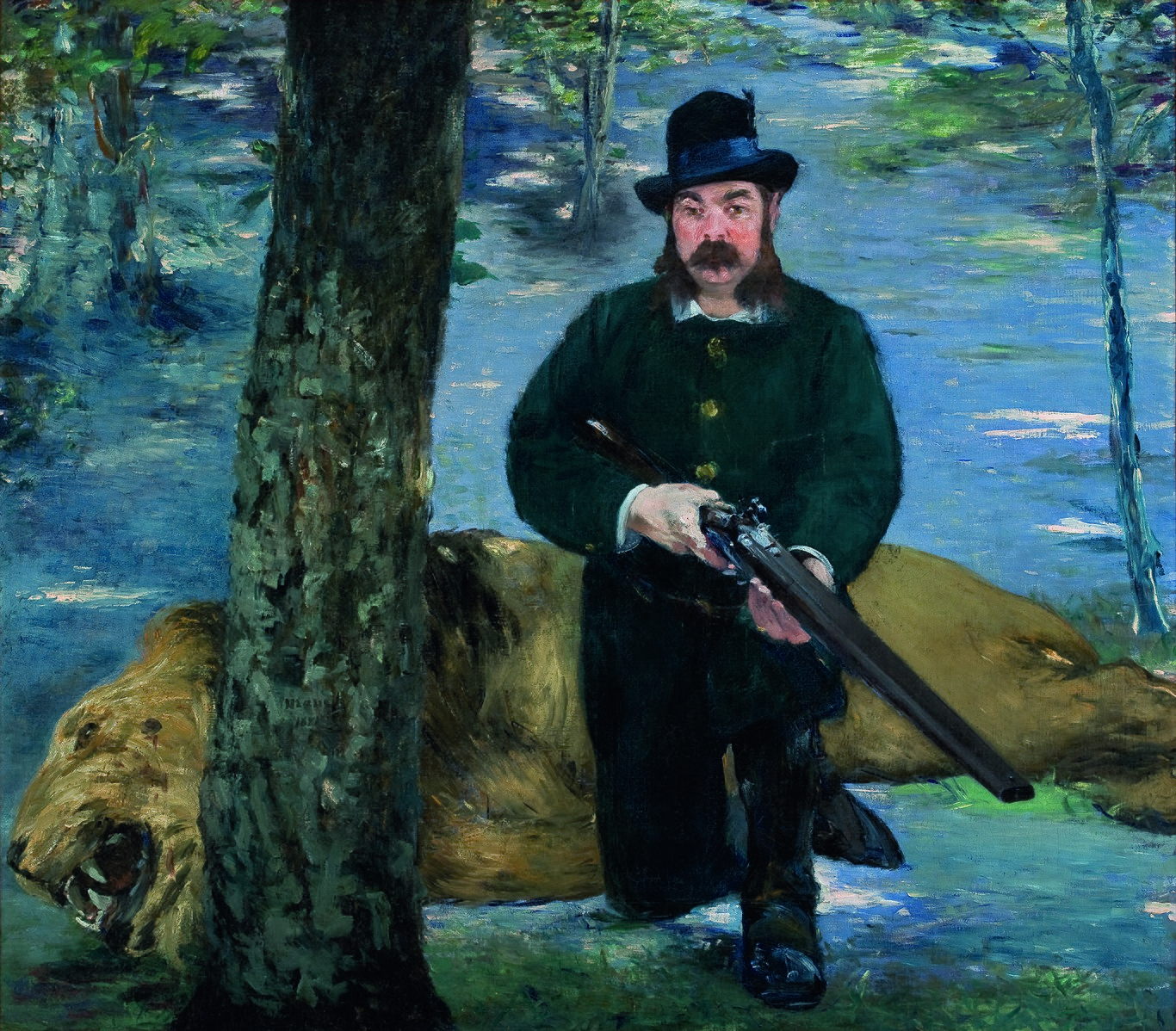
The large-format painting “Portrait of Pertuiset – Lion Hunter” was created in 1881, two years before the death of the artist. Manet, who had sought recognition from the Salon jury throughout his life, finally gained it with this painting, which earned him the long-awaited medal. It was the first official distinction in his career.
Immortalized by Manet, Eugène Pertuiset was a colorful character, inspiring many creators (including Jules Verne, who mentioned him in the story “Ten Hours of Hunting”). In 2008, this adventurer became the subject of a novel by Olivier Rolin, in which the author dedicated much space to the friendship between the portrayed and the artist. Pertuiset was an explorer and inventor who had a particular fondness for hunting predatory animals during expeditions to South Africa and America, a passion he proudly shared in Parisian salons. He was an admirer of Manet and owned several of the artist’s canvases, as Manet had invited him to his studio to paint his portrait since 1877, and Pertuiset took up the invitation three years later.
The model was immortalized against the backdrop of Manet’s garden, where the imposing silhouette of a reclining lion looks grotesque. The German hunting attire, more commonly seen in the Black Forest than on the Tanzanian plains, and especially the Tyrolean hat crowning the Frenchman’s sturdy figure, elicited ironic smiles from viewers. Even Manet’s signature, placed on a tree like carved initials of lovers, became a subject of mockery (a caricature mocking this element of the painting was published in “Le Journal Amusant”). Some contemporaries of Manet, including Renoir, claimed that the artist intentionally highlighted the subject’s comical aspects. Oliver Rolin refers to this aspect in his book, writing, “Pertuiset raved, spraying spit: about the expedition he was preparing to Tierra del Fuego, about savage cannibals, about the progress of humanity towards the glory of the homeland, about civilization at the ends of the earth, about his vocation to enlighten the world. Manet listens, amused, to this absurd fanfaronade. It’s a shame you can’t paint words. But – thinks Manet – I can paint the mouth that utters these words. It’s true that Pertuiset resembles a gnu, that is, an ox, deer, and horse all at once. A gnu that fells a lion, that would be funny. I’ll paint vulgarity again, but not affectionately, as I painted the beer drinker; I’ll portray Pertuiset so that his ridiculousness is glaring.”
Regardless of the numerous criticisms regarding the representational layer, the artistic merits of the painting were not questioned, and they were what led to the artist receiving the coveted distinction.
The acquaintance between the painter and the traveler lasted for years. Eugène Pertuiset acquired several of Manet’s paintings and, as an amateur, also engaged in painting. In 1884, he painted his own portrait as a lion hunter, which was presented at the Salon des Indépendants.
The painting remained in the possession of the portrayed Eugène Pertuiset in Paris until 1898 when it entered the Durand-Ruel gallery in Paris. Prior owners included Simon Oppenheimer (1911), Otto Gerstenberg from Berlin, and then the Katzenellenbogen family (also from Berlin). After 1923, the portrait was acquired by Max Silberberg. Following the Second World War, the painting was purchased with the funds of Vidigal and Geramia Lunardelli for the museum in São Paulo.
Painting Information:
oil on canvas, dimensions: 150 x 170 cm, current owner: Museu de Arte de São Paulo, São Paulo.
Literature: Daniel Wildenstein, Édouard Manet: Catalogue raisonné, Lausanne 1975, nr 365.