

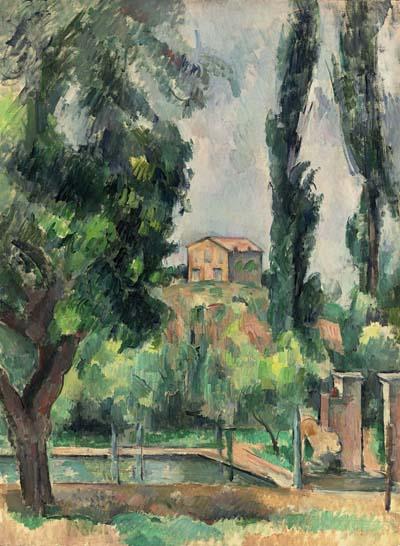
Paul Cézanne, Jas de Bouffan

Few interiors of the villa at Landsbergerstrasse 1-3 (currently Kutnowska Street), once owned by Max Silberberg, are known from archival photographs. Fortunately, photographs of the dining room, whose decor the collector commissioned from the renowned artist and director of the Academy of Fine Arts in Breslau, August Endell, have been preserved by a fortunate coincidence. The photos are black and white, but thanks to the preserved descriptions, we can fairly accurately reconstruct the appearance of the dining room. We know that the room’s walls were painted blue, and the white ceiling was adorned with linear gypsum moldings. The room was illuminated by a lamp made of copper sheet. A significant decorative element was the colorful, handwoven carpet with geometric patterns in shades of green, red, and blue, with accents of white and black. Green leather upholstery on chairs and armchairs, also designed by Endell, was color-matched to the carpet. The decor was complemented by a massive round table and cabinets covered with ebony veneer. In this stylistically unified interior, modernist paintings were hung, including van Gogh’s “The Bridge at Trinquetaille,” Renoir’s “Lecture,” and Cézanne’s “Jas de Bouffan.” We can therefore assume that the collector particularly valued these paintings, as he decided to exhibit them in this representative interior.


Cézanne’s work “Jas de Bouffan” already had an interesting and proud history before it found its place in the villa on Landsbergerstrasse. In November and December 1895, in Paris, the well-known art dealer and admirer of Cézanne’s work, Ambroise Vollard, organized a monographic exhibition of the painter in his gallery on Rue Laffitte. About 150 objects were presented during this exhibition. Despite sharp critics’ reviews, the exhibition attracted the interest of collectors and young artists, ultimately ensuring the artist’s recognition. One of the displayed canvases was a landscape from the surroundings of Jas de Bouffan near Aix, where the artist’s family home was located. It was also one of the last views of this place painted by the artist. In the foreground, there is a pool and the entrance to the orangery surrounded by the silhouettes of trees, and in the background, you can see the Italian-style villa, with the artist’s studio on the top floor.


The painting successively belonged to Sidney Brown in Baden, Paul Rosenberg in Paris (until 1921), and Galerie Thannhauser in Lucerne. In the 1920s, it became part of Max Silberberg’s collection. Later, it was in New York at J.K. Thannhauser’s salon, and then in the collections of Salman Schocken and Theodor Schocken. In 1966, the painting was auctioned at Parke-Bernet Galleries, where it was acquired by the American entrepreneur Henry Ford II, known for producing famous cars. In 1990, during an auction at Sotheby’s in New York, the painting was acquired by the Seibu company in Tokyo. Subsequently, the painting was auctioned at Christie’s in 2007.


Painting Information:

oil on canvas, dimensions: 71.7 x 53.3 cm, private collection.

Literature:

John Rewald, The Paintings of Paul Cézanne: a Catalogue Raisonné, New York 1996, nr 688.