


Otto Mueller, “Landscape” (verso: “Nude in Green”)
Otto Mueller was one of the most charismatic artists active in Breslau in the 1920s. He was from Lubawka, but arrived in Breslau in 1919 where he was offered a professorship at the State Academy of Arts and Crafts. Mueller was a member of the expressionist group “Die Brücke,” in english, “The Bridge” but he developed his individual style. This style was so distinctive that it couldn’t be mistaken for the work of other members of the group. His compositions, especially in later years, were painted dynamically with a thick brushstroke, full of vivid contrasts, often depicting landscapes with nude figures. Among the admirers of his paintings were Ismar Littmann and Gustava and Alois Landerer.
Otto Mueller passed away from tuberculosis in September 1930. He died at a sanatorium in Oborniki Śląskie. Five months later, in February 1931, he was honored with a monographic exhibition at the Silesian Museum of Fine Arts. Many collectors from Breslau lent their paintings for this posthumous exhibition of the artist’s works. One of these collectors was Ismar Littmann, who was closely associated with Mueller. This exhibition initiative was also supported by other collectors of Jewish descent, including Hans Pototzky, the owner of the insurance company “Pototzky & Co – Aktiengesellschaft für Versicherungswesen,” as well as the architect Richard Ehrlich, a close collaborator of Hans Poelzig, and the entrepreneur Rudolf Treuenfels.
After the Nazis came to power, official presentations of Mueller’s works were prohibited. The Nazis classified his pieces as examples of “degenerate art” (Entartete Kunst). The only exception was a propagandistic exhibition in Munich in 1937, where approximately 650 paintings confiscated from private collections and major museums in Germany were displayed. The purpose of the exhibition was to discredit avant-garde trends in modern art as incompatible with Nazi ideology. The Nazi time was difficult not only for the works of the expressionists but also for Jewish collectors who found themselves in danger. Those who did not emigrate often lost their lives in the Holocaust. Richard Ehrlich was murdered in Theresienstadt. Hans Pototzky emigrated to Oslo, where, during the German occupation, he was arrested and tortured by the Gestapo, resulting in his death.
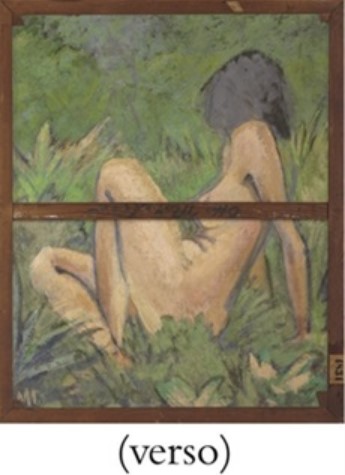
The Landerer and Trauenfels families recognized the threat posed by the Nazi regime in time and decided to emigrate.Both families took Mueller’s painting to New York, where it avoided the fate of other works confiscated as so-called “degenerate art”.
After the death of its owner, Lilly Landerer, Mueller’s “Landscape” was auctioned at Christie’s in 2007, that is the last of our knowledge on its current location.
Painting Information:
Tempera paint on thick canvas, dimensions: 97.5 x 119.1 cm, storage location unknown.
Literature:
Christie’s auction catalog of May 7, 2009 in New York, Number 244.