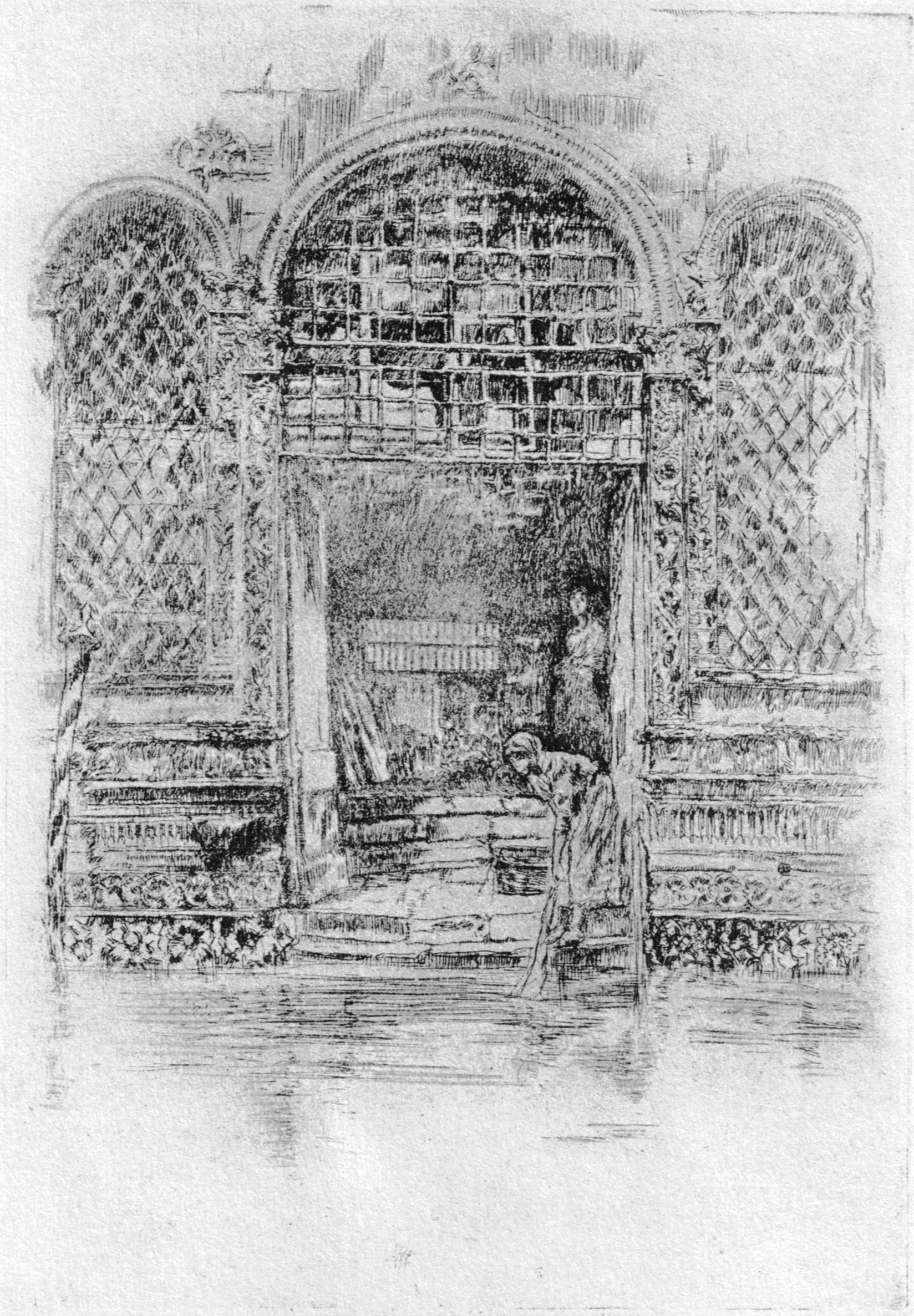


James McNeill Whistler, Gate
An important part of Carl Sachs’s collection consisted of a set of prints. Undoubtedly, among the most valuable works were the etchings of James McNeill Whistler, an American painter whose work reflects the influence of Impressionism. The artist was a fan of the restrained expression of Japanese graphics, which also found reflection in his own works. Sachs had numerous works by Whistler in his collection, including two rare etchings created by the artist in Venice titled “Little Venice” and “The Gate.”
“The Gate” is probably one of the views that Whistler sketched while sitting in a gondola in Venice. The work was part of a series commissioned by the London Fine Art Society. Whistler arrived in Venice in September 1879 and spent the next fourteen months there. The result of his work during that period was twelve excellent graphics. The etching depicts the richly decorated portal of Palazzo Gussoni located on Rio della Fava, near the Rialto Bridge. During Whistler’s time, there was a weaving workshop inside the shadowed interior, where a female figure is visible. The dark rectangular entrance contrasts with the building’s facade, illuminated by vibrating sunlight that settles on sculpted friezes, metal grilles, and reflects in the waves of the canal. The mastery of the graphic art is evident in the contrast between the ornamental upper part of the composition and the blurred section of the canal at the bottom of the image.
During the auction of Sachs’s print collection at Carl Gustav Boerner’s gallery in Leipzig in 1931, a high starting price of 4000 marks was proposed for “The Gate.” The next owner was the American writer and art enthusiast Atherton Curtis, who, in 1943, donated the etching to the Print Room of the Bibliothèque Nationale de France.
Print Information:
Etching, dimensions 29 x 20 cm, current owner of the Bibliothèque nationale de France, Cabinet des estampes, Paris.
Literature: Die Sammlung Carl Sachs. Graphik des XIX. Jahrhunderts. Versteigerung durch C.G. Boerner, Leipzig, und Paul Cassirer, Berlin/Leipzig 1931, nr 421.