

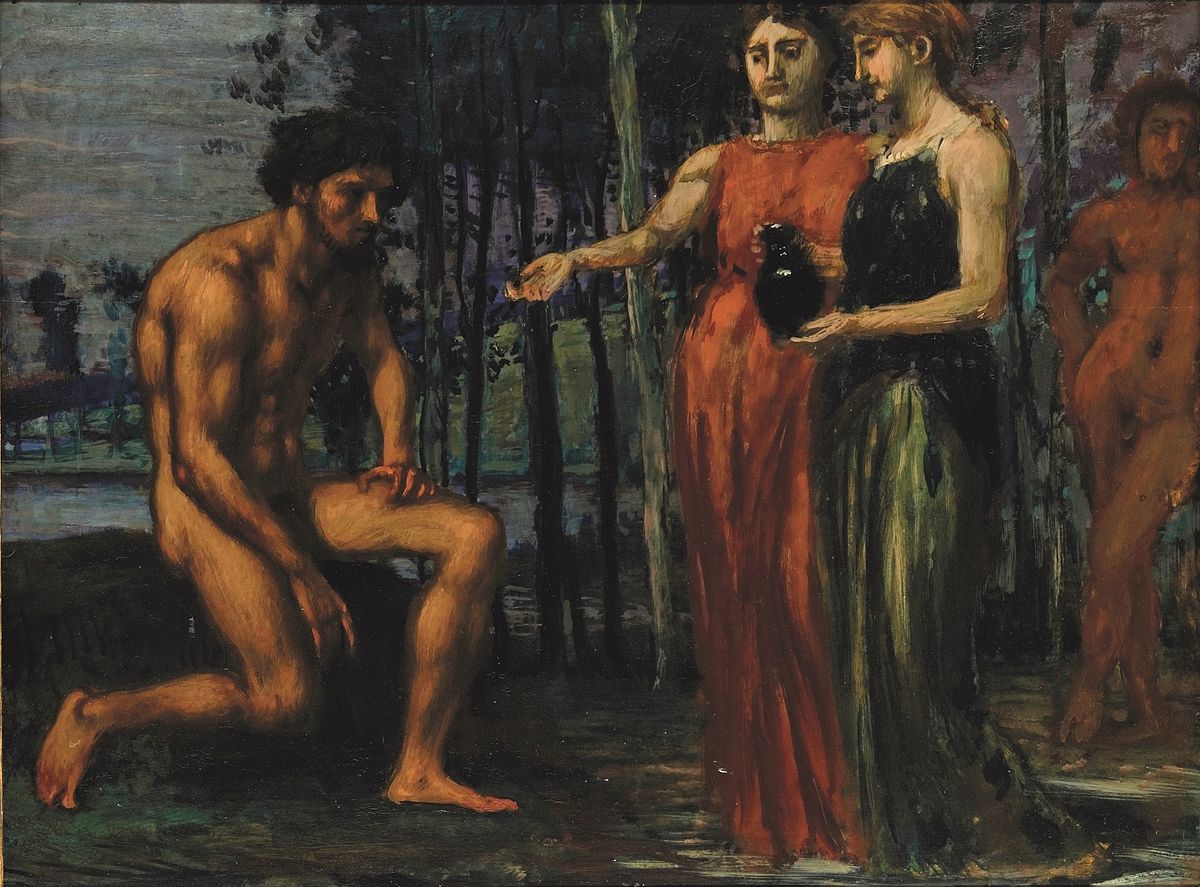
Hans von Marées was a German painter working in Italy. He often painted timeless scenes set in an antique-inspired setting, as exemplified by the composition depicting a naked young man to whom two young women are offering a refreshing drink.
This painting initially belonged to Professor Kleinenberg, a friend of Marées, whose portrait, also painted by Marées, was in the collection of Max Silberberg. In 1925, the artwork became the property of Zitzmann and was then auctioned on March 3 of the same year at the Cassirer-Helbing salon in Berlin. It was there that Max Silberberg acquired “Refreshment” for his collection. In 1935, faced with the worsening political and economic situation of the Jewish population, Silberberg was forced to sell this painting. On the 141st auction at Graupe’s salon, it was purchased by commissioner Carl Braunstein. In 1980, “Refreshment” became part of the Museum in Wiesbaden as a foundation from private collections.
In the wake of research initiated by the Washington Conference’s findings, the provenance of the painting was examined. Karl Scheffler published a photograph of the painting in an article describing Max Silberberg’s collection, facilitating the unequivocal identification of the canvas. The Museum in Wiesbaden proposed a very creative solution. The painting was turned back to front, presenting the information on its reverse side to the audience that if a certain amount, equivalent to the estimated value of the artwork, was raised within a specified period, the money would be returned to the collector’s descendants instead of the artwork. The campaign was widely covered by the media, and substantial donations quickly poured into the museum’s coffers, which, along with funding from other cultural organizations, were enough to reach a settlement with the rightful owners.