

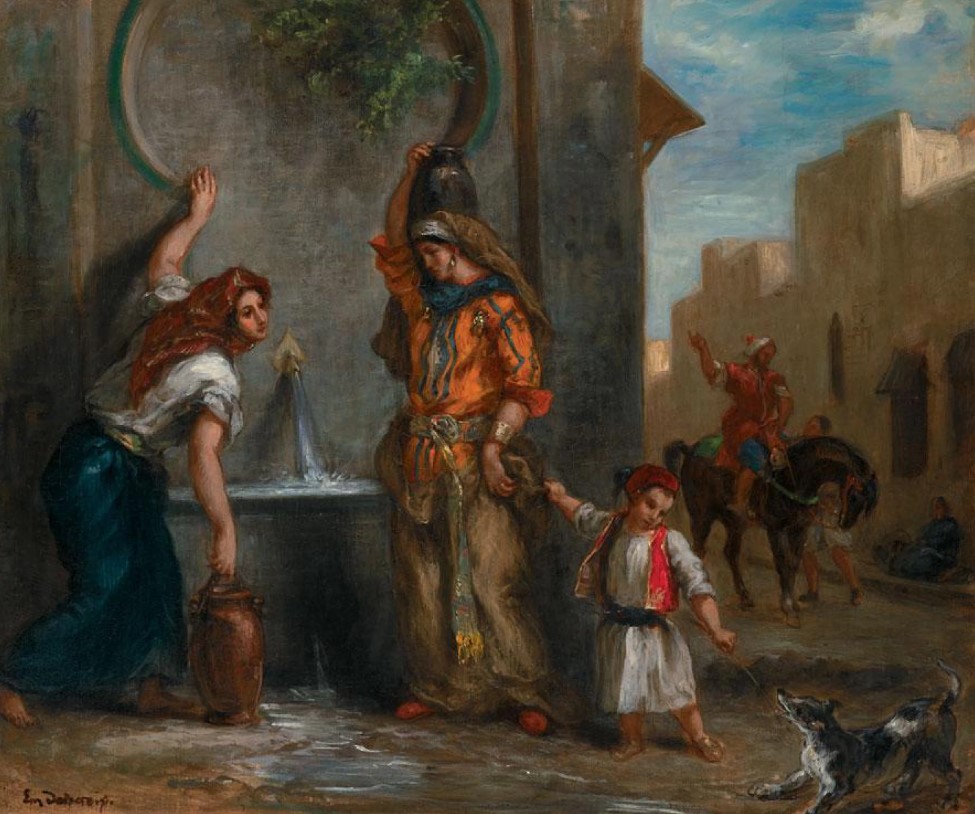
A significant group of works in the Silberberg collection consisted of paintings by eminent 19th-century French artists representing Romanticism and Realism. The oldest among them, born at the end of the 18th century, was Eugène Delacroix. When, on June 22, 1854, the artist noted in his journal the completion of the composition “Women at the Well,” he most likely referred to the canvas that would find its way to the collection of the art enthusiast from Breslau many years later. It was based on a watercolor sketch painted by the artist in 1832, during the latter part of his six-month journey through North Africa, visiting Algiers. The result of this expedition was his long-standing fascination with exotic countries, expressed in hundreds of paintings and drawings dedicated to this theme. Delacroix was one of the first painters familiar with the culture of Morocco and Algeria firsthand, with their characteristic landscapes, Moorish architecture, and attire. However, it seems that the most profound impression on the French painter was made by women dressed in beautiful, colorful costumes. Quick, schematic sketches of Muslim girls, who, due to cultural reasons, could not pose for the artist, served as the basis for many later painted compositions. Compared to the works of earlier artists, such as the idealized paintings of Jean Auguste Dominique Ingres, Delacroix’s vision appears much more convincing. There are fewer elaborate hairstyles, costumes, and accessories; the models pose naturally, and their gazes do not meet the viewer’s eyes. The “Odalisque Resting on an Ottoman,” once owned by Silberberg, is one of the most famous compositions of this kind, created a few years before Delacroix’s North African journey. Still, even in this early canvas, the artist managed to achieve a sense of naturalness.
The painting mentioned in the artist’s diary in 1854 remained in the possession of the Parisian galerie Georges Petit for a long time, and in 1927, it was in the possession of the antiquarian Georges Bernheim. Max Silberberg acquired it from this last owner, most likely before 1930. However, he lost it after 1934. The painting then came into the possession of the Cozziga family (Greece, Egypt) and later into unknown private collections. The artwork was offered for sale in 2006 at an auction at Sotheby’s in London. Before its sale, an agreement was reached between the then-owners and the descendants of Max Silberberg, in accordance with the Washington Conference Principles on Nazi-Confiscated Art.
Painting Information:
oil on canvas, dimensions: 55 x 65 cm, current storage location unknown.
Literature: Karl Scheffler, Die Sammlung Max Silberberg, „Kunst und Künstler“, 30 (1931), s. 3-18.