

In the 1880s, Degas began to experience difficulties with his eyesight, leading him to experiment with new techniques, including sculpture and pastel, which combined drawing and painting techniques. Pastel, due to the softness of the strokes and its characteristic texture that didn’t require precise outlines, became one of the artist’s favorite mediums. It allowed him to create intimate scenes, formally modest but rich in color and movement.
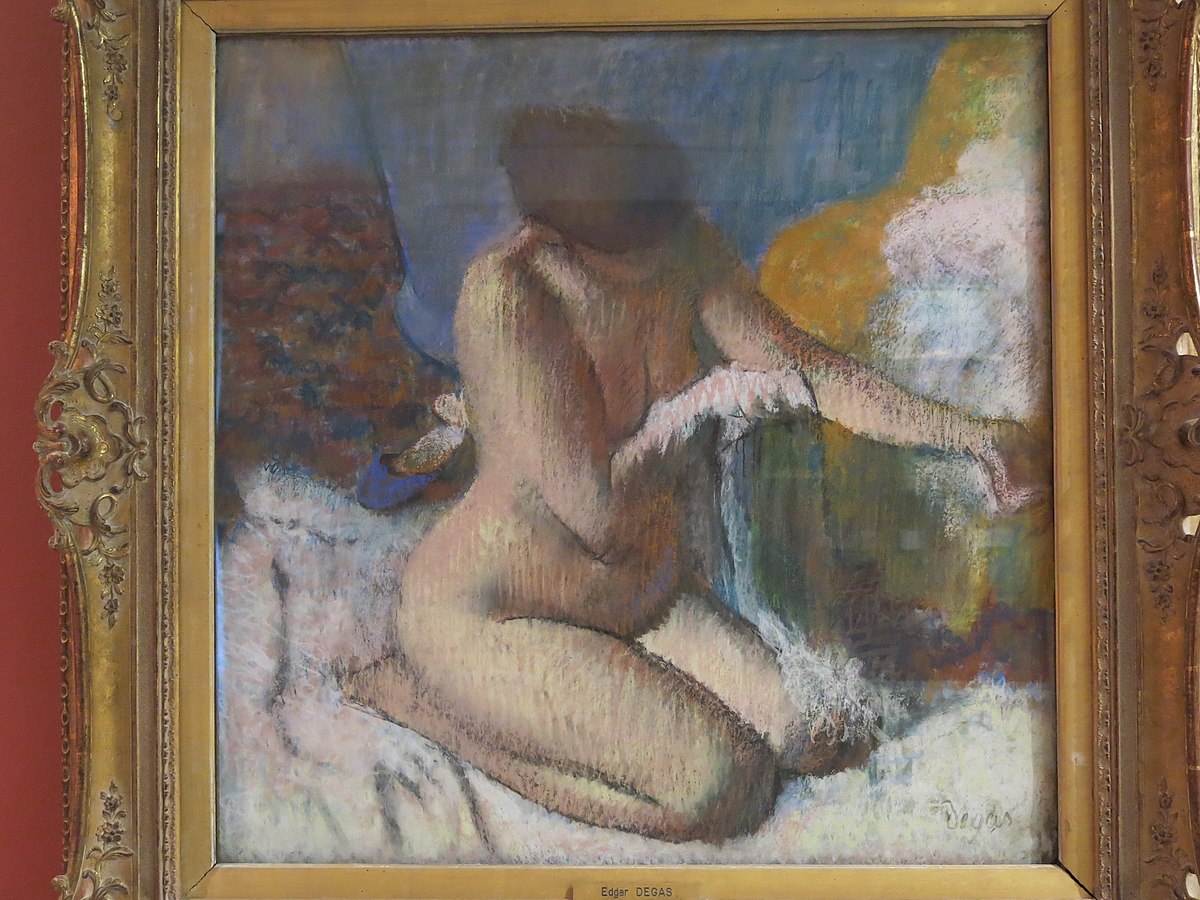
The perfect utilization of pastel technique is evident in the composition “After Bathing,” once owned by Max Silberberg. Today, we can admire this work in the Louvre. It depicts a woman drying herself after a bath. In the last decades of Degas’s life, such scenes, along with depictions of dancers, became his favorite subjects. The artist created over two hundred compositions of this kind, often featuring models with long, reddish hair. The hair’s intricate patterns form an intense splash of color at the center of the painting. In the painting that once belonged to Silberberg, “After the Bath,” the silhouette of a naked woman sitting on white fabric is highlighted against a yellow-blue background.
The composition reflects the characteristic capture of a moment typical of Impressionist painting. It does not aspire to convey important messages or allegorical themes. For Degas, creating a masterpiece only required the beauty of the model, the play of light and shadow on her skin, and the contrasting combination of vibrant colors in the background.
Between 1895 and 1896, the painting belonged to Paul Durand-Ruel, who purchased it directly from the artist. In 1896, it entered the collection of M. von Seidlitz in Dresden, from where it was acquired by Max Silberberg no later than 1931. A year later, along with other paintings from Silberberg’s Breslau collection, it was auctioned at the Georges Petit gallery in Paris. It was then purchased for the Schoerell collection. In 1961, it came into the possession of Hélène and Victor Lyon, who donated it to the Louvre, where it is currently exhibited.
Painting Information:
pastel on paper, dimensions: 70 x 70 cm, Musée du Louvre, Paris.
Literature:
Collections de Messieurs S… et S…, Tableau Modernes, Paris, 9 Juin 1932, Galerie Georges Petit, Paris 1932, nr 6.