

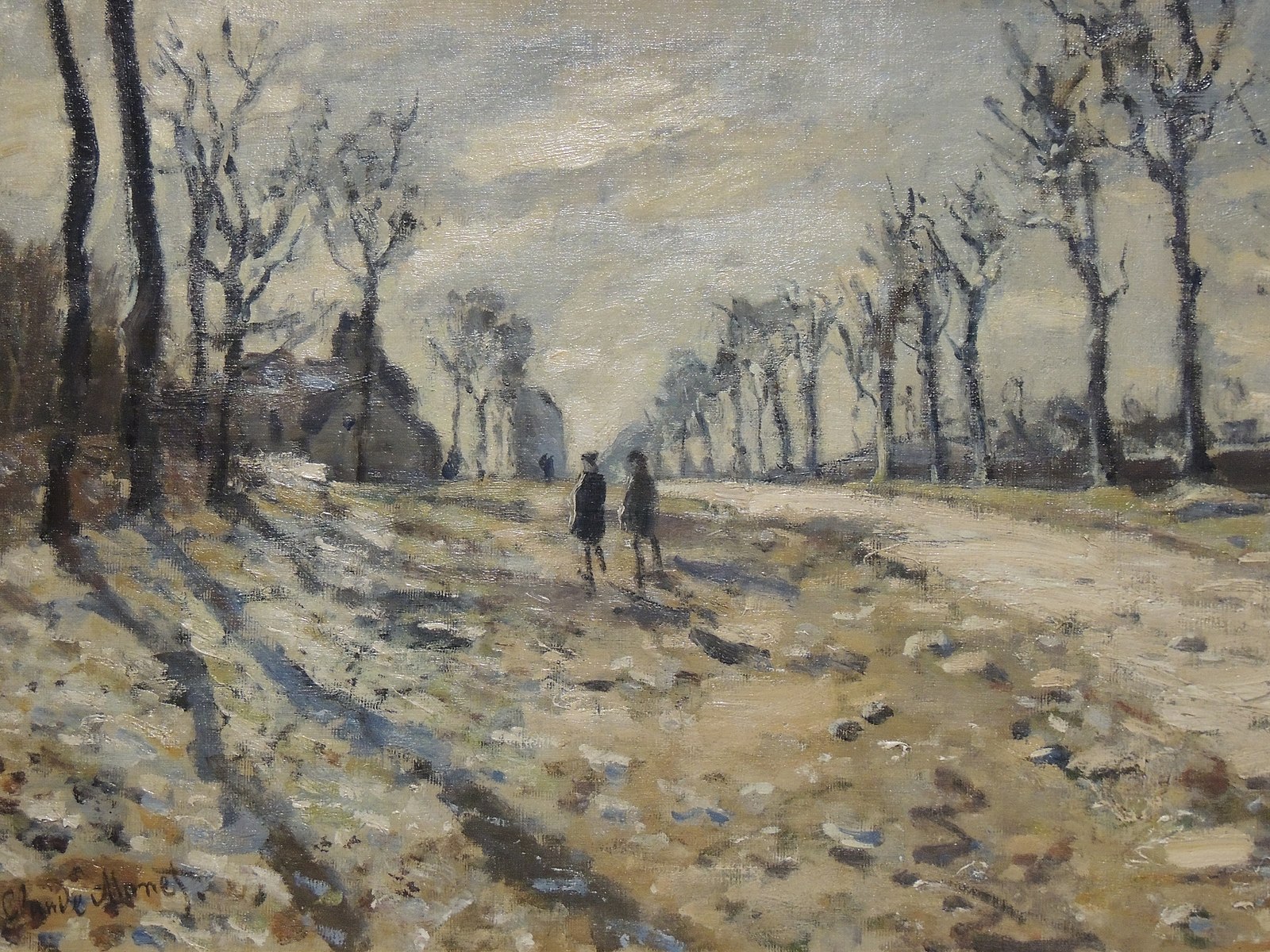
Painted by Monet in 1869, the picture depicts a street in Louveciennes covered with melting patches of snow reflecting the evening sun. Initially an apparently unattractive view of a small-town road covered in mud, under the painter’s brush, it transformed into a vibrant composition illuminated by light, captivating the viewers.
Snowy landscapes were often a subject explored by Claude Monet. The most well-known ones are from the series of haystack representations created in the last decade of the 19th century. In these works, the artist captured haystacks at various times of the day and year. As seen in Silberberg’s example, early in his artistic journey, Monet also took on the challenging task of portraying sunlight reflections on the surface of snow. One of the long tree-lined avenues in Louveciennes, which inspired many artists, transformed under Monet’s brush into an almost symbolic landscape reminiscent of some of Caspar David Friedrich’s masterpieces. In these, small human figures were dominated by the predatory silhouettes of leafless trees. Perhaps to provide comfort to the figures lost in the winter landscape, Monet presented them in pairs rather than individually, similar to the composition depicting a road in Argenteuil from the National Gallery in London. The composition is further enlivened by the warm rays of the setting sun.
The small town of Louveciennes, just half an hour by train from Paris, was immortalized by famous Impressionist painters in over a hundred canvases. It was the home of Renoir’s mother, whom the artist frequently visited. During the crucial period for the birth of Impressionist painting in the late 1860s and early 1870s, Pissarro also lived there. Sisley and Monet also created works in Louveciennes.