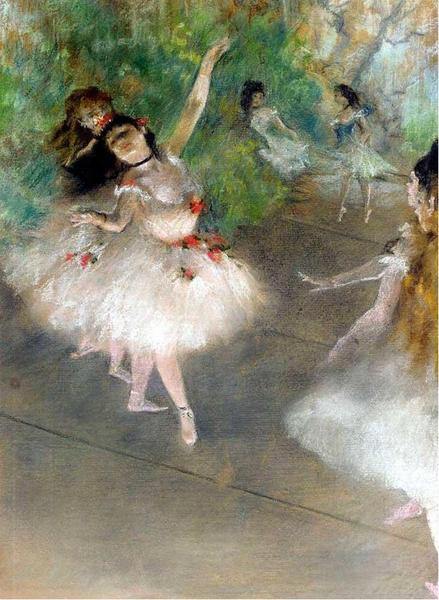
“In his portraits, he sought to achieve a sense of space and form, simultaneously employing the most unexpected perspectives. Therefore, themes related to ballet appealed to him more than landscapes. Watching rehearsals, Degas had the opportunity to observe human bodies from various angles. Viewing the stage from above, he saw dancing and resting girls, studied complex perspective foreshortenings, and the impact of stage lighting on modeling […] His paintings tell no story. He was not interested in ballerinas because they were pretty girls. It seems he didn’t care about their moods. He looked at them with the same indifferent objectivity that the impressionists looked at landscapes. What mattered to him was how light and shadow played on the human figure and how to achieve a sense of movement and space. He demonstrated to the academic world that the new principles established by young artists could be reconciled with perfect drawing, but to achieve this, entirely new problems had to be solved, challenges that only a true master could meet.”
The painting from the collection of the Breslau industrialist is an example of the interesting technique employed by Degas. It was based on monotype, on which the final composition was created using dry pastel, resulting in very deep color saturation and luminosity. In the once-decorating Silberberg’s villa, the painter made the tutus of the ballerinas carriers of light, illuminated by the rays from the spotlights surrounding the stage. Thanks to the contrast between the red rosebuds adorning the soloist’s costume and her dark hair, as well as the vibrant spots of green and blue in the background, the pastel gains extraordinary dynamism.
The painting was part of the collections of Samuel Jean Pozzi in Paris and Alexandre Rosenberg in the same city. It then entered the collection of Baron Móric Lipót in Budapest, and later into Max Silberberg’s possession. In 1932, along with other paintings from the Breslau collection, it was sold at auction at the Galerie Georges Petit in Paris, where Helmuth Lutjens, working for Paul Cassirer, acquired it. The next owner was Paul Rosenberg from Paris, from whom an anonymous collector purchased it in 1938. The composition was auctioned at Sotheby’s in London in 2002.
Painting Information:
pastel on paper, dimensions: 38 x 28 cm, current storage location unknown.
Literature: Karl Scheffler, Die Sammlung Max Silberberg, „Kunst und Künstler“, 30 (1931), s. 3-18.