

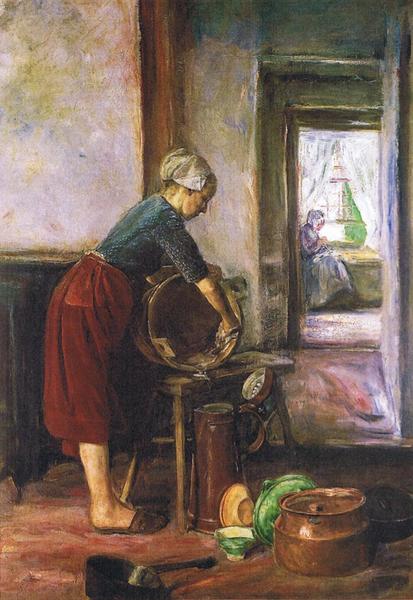
In Silberberg’s collection, works by the great trio of German Impressionists, Max Liebermann, Max Slevogt, and Lovis Corinth, were not lacking. Silberberg corresponded with Liebermann, and in September 1921, the painter wrote in a letter to Silberberg: “At the same time, thanking you, I confirm the receipt of a check amounting to 10,000 marks for the pastel you purchased, and I am very pleased that you liked it, as I learned from your letter. What can be more pleasant for an artist than the awareness that his works have found a place in the hands of an art lover?”
At that time, in addition to the mentioned pastel, Silberberg already owned at least one Liebermann canvas – “Polo Players” from 1907, purchased a year earlier from Paul Cassirer. Later, at least three more paintings were added, including “Market in Haarlem,” now in the collection of the Georg Schäfer Museum in Schweinfurt, as well as “Tailor Shop in Amsterdam.” The latter painting was in the collection of the Bündner Kunstmuseum in Chur, Switzerland until October 1999 when it was returned to its rightful owners.
The third painting is the one presented here, “In the Kitchen” from 1883, which was known to the local audience because it previously belonged to the well-known brewery owner in Wroclaw, Georg Kissling, and was exhibited in 1911 at the fourth exhibition of contemporary painting at the Silesian Museum of Fine Arts in Wroclaw.