

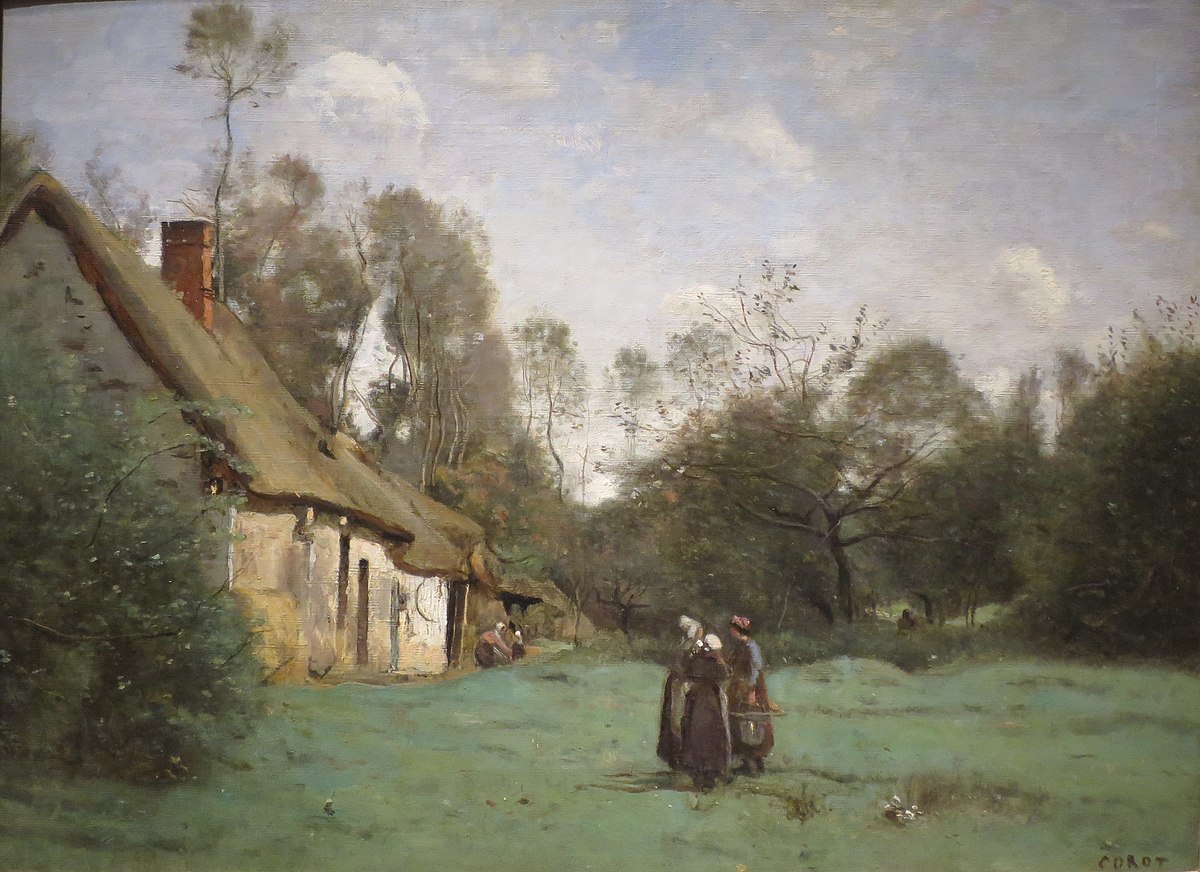
Julius Meier-Graefe, an art critic who resided in Paris for many years, played a significant role in popularizing the works of French painters in Germany, especially those of Jean-Baptiste Camille Corot and Gustave Courbet. It is known that the critic was acquainted with Silberberg, and it can be presumed that he encouraged the collector to acquire works by these artists. It is speculated that under his influence, three paintings by Jean-Baptiste Camille Corot were purchased for the Breslau collection, which Meier-Graefe published in 1930 in the monograph dedicated to the artist. One of them was the canvas “Thatched Cottage in Normandy.”
The composition was created when the elderly artist, celebrating his seventy-sixth birthday in the summer of 1872, embarked on a several-month journey across France, resulting in numerous landscapes. At the posthumous exhibition of the artist less than three years later, this painting was among the works selected by his students and friends, and a few decades later, it came into Silberberg’s possession.
In 1875, the artist sold this painting for 2000 francs to Beugniet in Paris. Subsequent owners included Guibert, John Saulnier (until 1886), Professor Dieulafoy (until 1928), and Laulitier from Paris. Before 1930, the painting, perhaps at the persuasion of the renowned critic Julius Meier-Graefe, was acquired by Max Silberberg.
The painting, sold at an auction in 1932 at Georges Petit in Paris, entered the collection of Mrs. Berard and later became part of the collection of Alfred Chester Beatty in London (until 1960). In 1968, the landscape was purchased by the well-known collector Norton Simon from the New York gallery of Stephen Hahn. Paintings from his collection form the core of the museum in Pasadena, and many of them, including Corot’s work, are on permanent display.
Painting Information:
oil on canvas, dimensions: 45.1 x 61.2 cm, Norton Simon Foundation, Pasadena.
Literature:
Richard R. Brettell, Stephen F. Eisenmann, Nineteenth-Century Art in the Norton Simon Museum, Yale 2000, nr 24.