

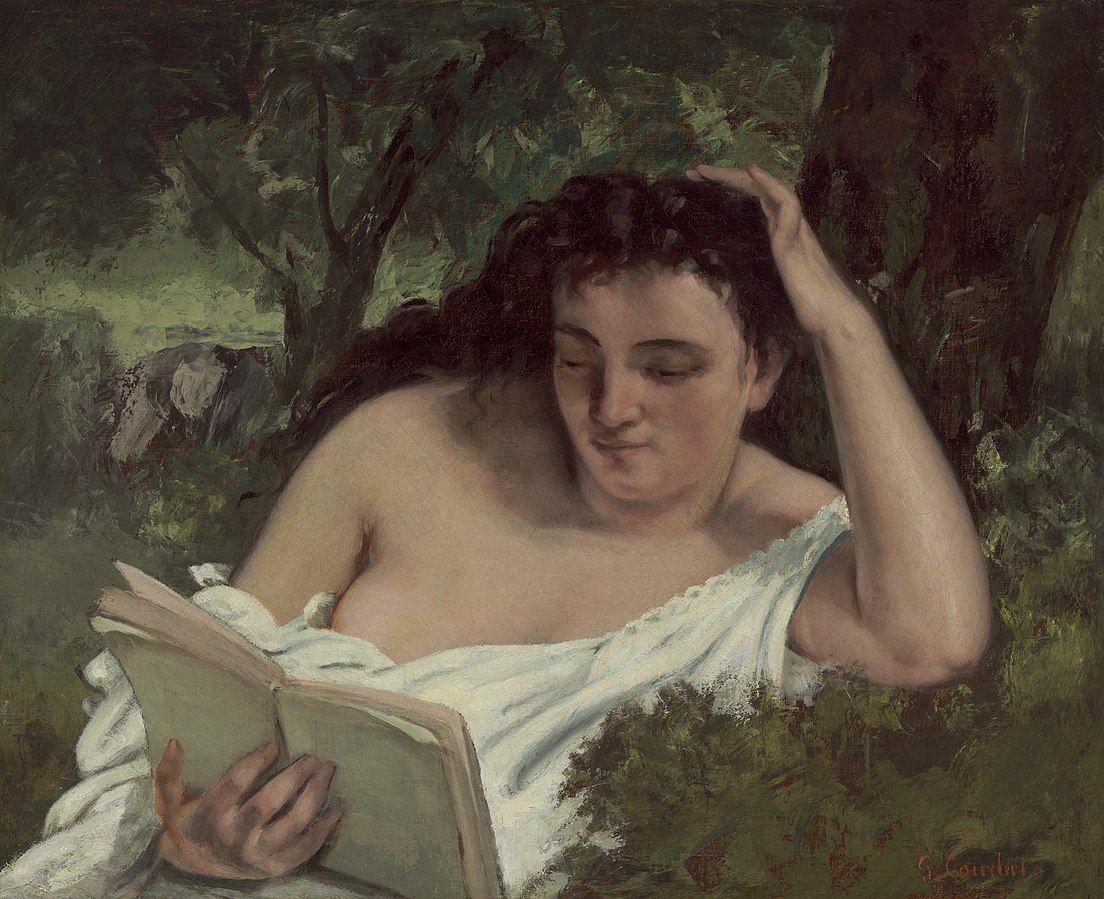
In Max Silberberg’s villa on Landsbergerstrasse, there were at least three canvases by Gustave Courbet, including “Reading,” now a pride of the Washington National Gallery, “Rock of Hautepierre,” displayed at the Art Institute in Chicago, and “Le Grand Pont,” previously owned by Leo Lewin and currently in the collections of the Yale University Art Gallery.
Gustave Courbet was an outstanding painter, one of the most well-known representatives of realism. Coming from a landowning family, he was characterized by a rebellious attitude towards reality and skepticism towards institutionalized art practices. He did not shy away from controversial subjects and depictions.
The presented canvas, “Young Woman Reading,” belongs to the typical compositions of the artist and portrays a young woman immersed in reading, a scene that had previously inspired many renowned artists. The work was created around 1868 and was presented to the wider public at a posthumous exhibition of the painter in Paris in 1882. The artist consigned this painting for sale to the Parisian gallery Durand-Ruel. Three years later, the canvas went up for auction by a certain “comte de R…” at Hôtel Drouot in Paris. Subsequent owners included Parisian collectors Reitlinger, Alexandre Bernheim-Jeune, and Alexandre Berthier, with the fourth owner being Prince de Wagram. In 1924, the canvas appeared in the Amsterdam salon of E. J. van Wisselingh & Co, and later at Paul Rosenberg’s in Paris. Before 1931, it entered the collection of Max Silberberg, and in 1932, the painting was sold at an auction of several works from Silberberg’s collection at Georges Petit in Paris. Subsequently, “Young Woman Reading” came into the possession of Chester Dale, along with another canvas from Silberberg’s collection, Renoir’s portrait “Marie Goujon.” After Dale’s death, the painting “Young Woman Reading” found its way to the Washington museum.
Painting Information:
oil on canvas, 60 x 72.9 cm, National Gallery of Art, Washington.
Literatura:
Karl Scheffler, Die Sammlung Max Silberberg, „Kunst und Künstler“, 30 (1931), s. 3-18.