

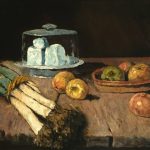
Carl Schuch is one of the most important painters of Austrian realism, primarily known for his still lifes and landscapes. In the 1880s, he lived in Paris, and the works created during this period, including the still life owned by Max Silberberg, show a the influence of French painting styles. Schuch studied the works of Chardin, Corot, and Manet during his time in Paris, and his paintings reflected this, as seen in the limited selection of objects and the contrasting representation of items against a dark background. The composition “Still Life with Leeks” consists of few elements: a few apples, a bunch of leeks, and cheese under glass cover on a wooden table. These simple objects, painted with bold brushstrokes, create a harmonious yet dynamic play of light and shadow.
Max Silberberg was the first documented owner of the painting. As an engaged contributor to the culture of Breslau, he reached an agreement with the Silesian Museum of Fine Arts in 1920, donating the painting to the institution. The understanding was that the painting would temporarily remain in Max Silberberg’s possession and, only after his death and that of his wife, would “directly become the property” of the Museum. Thanks to this agreement, we can be certain that the canvas belonged to Silberberg.
Upon the rise of the Nazis to power, the agreement was broken. In 1939, the systematic confiscation of Jewish assets began in Breslau. In the same year, Carl Schuch’s painting found its way to the museum, even though the Silberberg family had not yet been deported and lived in Breslau until October 1941. In June 1942, the painting was secured in a depot in Kamieniec Ząbkowicki (then Kamenz). After the war, it was kept in hiding by the new Polish authorities, who later transferred it in 1946 to the National Museum in Warsaw.
Painting Information:
oil on canvas, dimensions: 56.5 x 76 cm, in the collection of the National Museum in Warsaw.
Literature:
Karl Scheffler, Die Sammlung Max Silberberg, In: „Kunst und Künstler“, 30 (1931), S. 16.
German painting in the 19th century. Paintings from Polish collections, exhibition at the National Museum in Warsaw, ed. Iwona Danielewicz, Agnieszka Ciska, Warsaw 2005, p. 109.