

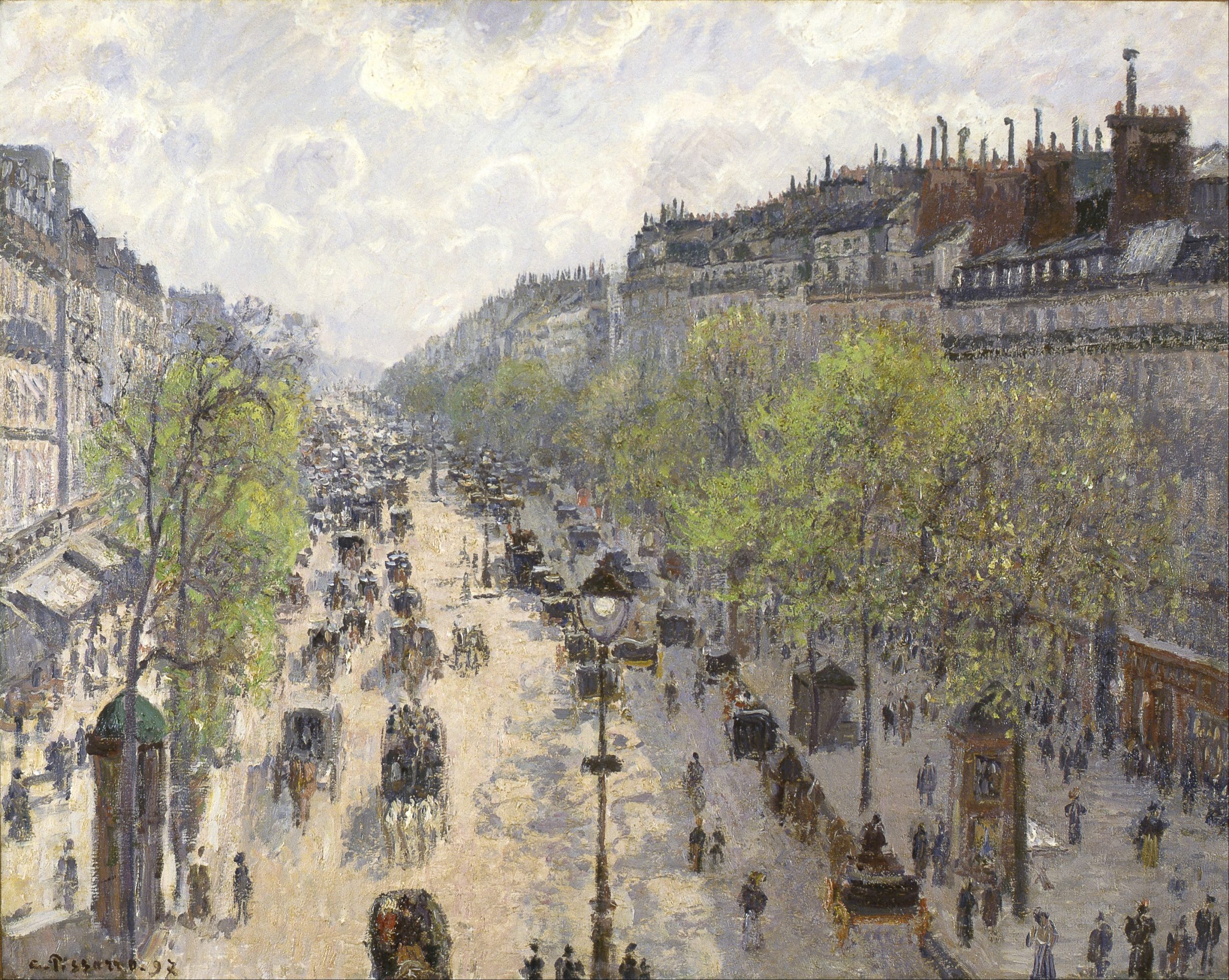
“Boulevard Montmartre, Spring 1897” is one of Camille Pissarro’s most famous paintings, part of a series of fourteen views of a lively urban thoroughfare at different times of day and year, and in various weather conditions. This cycle is the most significant group of cityscapes in the painter’s body of work.
In the winter of 1897, Pissarro arrived in Paris and stayed at the Grand Hotel de Russie on Boulevard Montmartre. Working in the hotel room was an ideal solution for the painter, who suffered from eye sensitivity and couldn’t work outdoors for extended periods. Many canvases created at the Grand Hotel de Russie, including the painting later acquired by Silberberg, were bought from Pissarro by the owner of the renowned gallery Paul Durand-Ruel. Subsequent owners included Mr. Burke from London, then the firm Arthur Tooth & Sons, London. In 1901, the canvas reappeared at the Galerie Durand-Ruel in Paris, and a year later, it was purchased by the well-known antiquarian Paul Cassirer in Berlin. From him, the painting was acquired by the collector Adolf Rothermundt in Dresden, and the next owner was Max Silberberg. After being forcibly sold at the auction of Paul Graupe in Berlin due to Nazi persecution of the Jewish population, the artwork ended up in the hands of several New York collectors and was offered to The Israel Museum in Jerusalem in 1997 by the American Friends of the Museum.
In November and December 1998, representatives from 44 countries and various cultural institutions gathered in Washington, D.C., invited by the USA, to address the issue of property seized during the Holocaust. The conference aimed to find a solution regarding Nazi-looted art and encourage institutions and private owners to conduct provenance research and seek amicable agreements with rightful owners, such as the restitution of looted artworks. One of the paintings widely commented on in the media was Camille Pissarro’s “Boulevard Montmartre, Spring 1897.”
In the case of this painting, there was no doubt that it was sold at a forced auction of Max Silberberg’s collection at Paul Graupe’s Berlin salon in 1935. The provenance of the painting donated in 1997 to the Israel Museum from Silberberg’s collection led to discussions with Gerta Silberberg, the collector’s daughter-in-law. She agreed that the painting wouldn’t leave the Jerusalem institution but would remain there on deposit. Gerta’s condition was to place a plaque next to the painting informing about the convoluted fate of the canvas and the figure of the Breslau collector. After Gerta Silberberg’s death, the painting went to the auction house Sotheby’s. In 2014, it was auctioned for just under £20 million to a private collector.
Painting Information:
oil on canvas, 65.5 x 81 cm, currently in a private collection.
Literature: Joachim Pissarro, Claire Durand-Ruel Snollaerts, Pissarro: Critical Catalogue of Paintings, Paris-Lausanne 2005, nr 736.